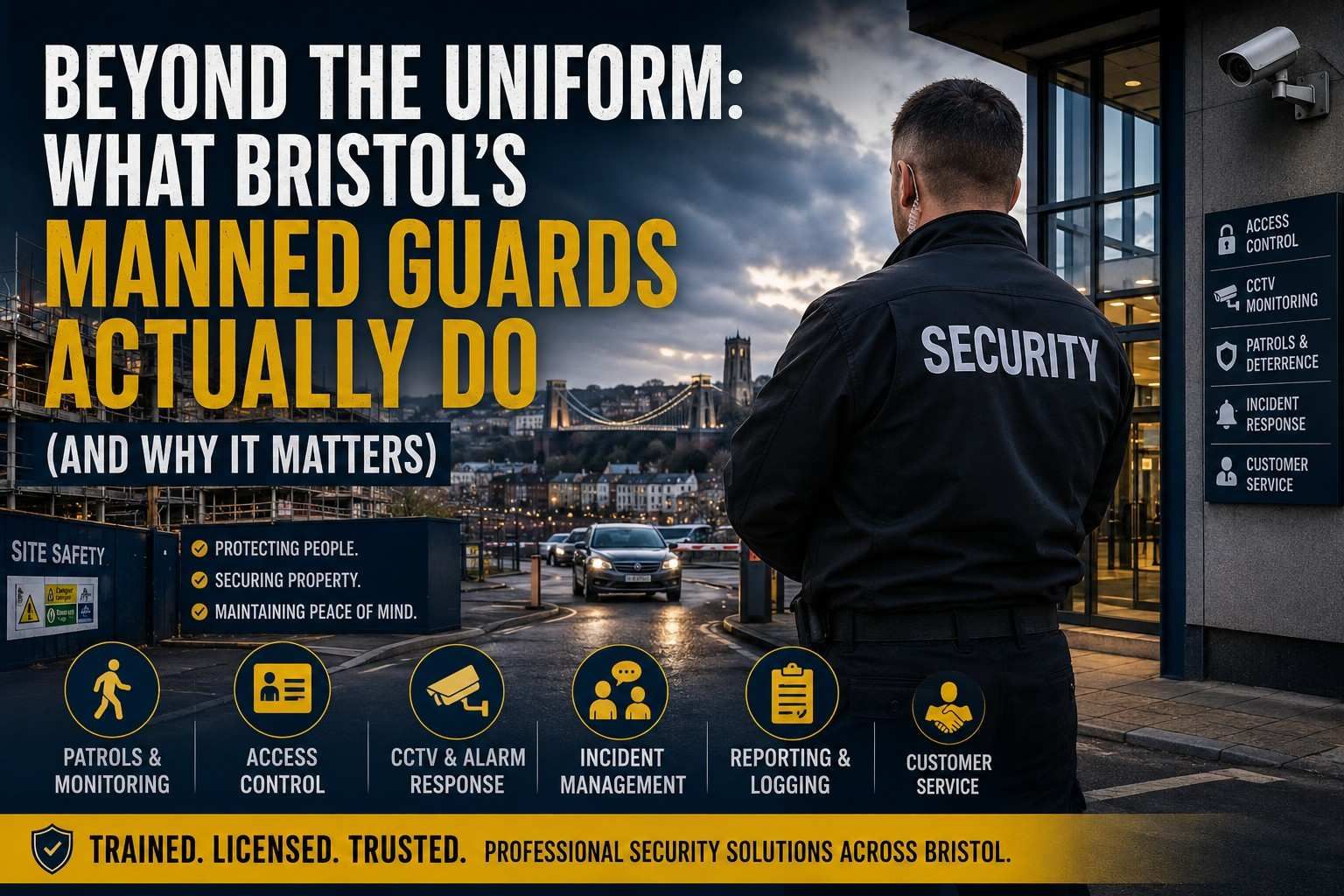
Beyond the Uniform: What Bristol's Manned Guards Actually Do (And Why It Matters)
Most people see a security guard and think they've got it figured out. Stand around. Look serious. Check a few IDs. Simple job, right? Wrong.
The reality of what a professional security officer does every day is far more complex. In a city like Bristol, where the crime rate sits at 143.5 per 1,000 residents, the gap between what people think guards do and what they actually do matters a lot.
Under the Private Security Industry Act 2001, anyone undertaking manned guarding must hold a valid SIA licence. That's not optional. Getting that licence requires specific training in roles and responsibilities, access control, and physical protection systems. But that training is just the start.
What Manned Guards Actually Do
The day-to-day work varies enormously depending on the site. A guard at a Bristol construction site faces different challenges than one at a city centre retail store. But there's a common core.
Patrolling and monitoring
This isn't walking around aimlessly. Officers secure doors, windows, and entry points. They check for forced entry. They look for hazards. They maintain a visible presence that deters offenders. On large industrial sites or business parks, patrols are timed and routed to maximise coverage.
CCTV and alarm response
Many guards monitor cameras and respond to alarms. But it's not passive. They watch for suspicious behaviour. When an alarm triggers, they investigate. They assess the situation. They decide in real time whether to call the police, intervene, or stand by.
Access control
Checking staff and visitors in and out sounds straightforward until you're managing a busy construction site with dozens of contractors arriving at 7 am, or a corporate office with constant deliveries. Guards verify identities, issue passes, log entries, and ensure nobody enters restricted areas.
Incident response and de-escalation
This is where the job gets real. Guards are often first on the scene when something goes wrong. A fight breaks out. A visitor becomes aggressive. An intruder is spotted. They're trained in conflict management. They know how to talk people down. They know when to step in and when to hold back.
Incident logging and reporting
Every significant event gets documented. Accurate logs are critical for insurance claims, police investigations, and legal proceedings. A good guard doesn't just deal with a situation and move on. They record what happened, when, and who was involved.
Customer service
This surprises people. But security officers are often the first point of contact for visitors, delivery drivers, and contractors. They answer questions. They give directions. They represent the business they're protecting.
Health and safety duties
Guards patrol for safety too. Spotting trip hazards. Checking fire exits and reporting faults. On a construction site or warehouse, this can be as important as any security function.
Why It Matters for Bristol Businesses
Bristol's crime picture is challenging. Total offences in the 12 months to September 2025 reached 63,843. Crime rose by around 8.3% compared to the previous year. Violent offences lead with around 27,700 cases. Public order crime reached about 7,800 by February 2026, up 3.7% year on year.
Almost one-quarter of Bristol residents are affected by a fear of crime in their day-to-day lives.
That fear has consequences. Staff who don't feel safe don't perform well. Customers who feel uneasy don't come back. Businesses in high-crime areas struggle to recruit and retain employees.
This is where professional manned guarding Bristol makes a genuine difference. A visible, trained guard changes behaviour. Not just criminals. Of everyone. Staff feel more confident. Visitors feel more welcome. Contractors take the site more seriously. The psychological impact of a uniformed presence is measurable and real.
Consider the alternatives. CCTV cameras record, but they don't react. Fences can be cut. Alarms can be ignored. Only a human being can assess a situation in real time, make a judgment call, and take appropriate action. Only a human being can de-escalate a tense confrontation before it becomes violent.
The data backs this up. In 2024, Bristol's Retail Rangers recovered goods worth £37,686. Many more incidents were completely prevented. That's a tangible return on investment.
The SIA Licence: More Than Just a Piece of Paper
You'll hear "SIA licensed" a lot when looking for a security company in Bristol. It matters more than you might think.
The Security Industry Authority regulates the private security industry. They don't license businesses. They license individuals. Every single guard deployed by a reputable security company Bristol has been vetted, trained, and approved.
What does that training cover?
Roles and responsibilities of a security officer
Access and egress control procedures
Electronic and physical protection systems
Communication and conflict management skills
Front-line licence holders must wear their licence where it can be seen at all times when working. That's not bureaucracy. It's accountability. If you can see a guard's licence, you know they're legitimate.
Different Sites, Different Skills
What works for one business won't work for another. A professional security company Bristol understands this.
Retail sites need guards who can manage theft and protect staff safety. Shoplifting in Bristol hit a 20-year high in 2025, with 10,885 crimes reported. Only 7% resulted in a suspect being charged. Prevention matters more than prosecution. A visible guard stops theft before it happens.
Construction sites need guards who can protect expensive materials and equipment. Theft of plant and equipment is a persistent problem in areas like Severnside and Brislington. A single stolen digger attachment can cost thousands.
Warehouses and logistics hubs need guards who can control vehicle movements and secure high-value stock. Large perimeters and multiple entry points require officers who understand traffic management and supply chain security.
Corporate offices need guards who present a professional image while maintaining strict access control. They're often the first person a visitor meets. That matters.
The Human Cost of Getting It Wrong
Security work is dangerous. Guards face verbal abuse, threats, and physical violence regularly. In August 2024, a security guard was assaulted during a break-in at a defence factory near Bristol. The attackers used sledgehammers and whips.
That's an extreme example, but it's not isolated.
Door supervisors deal with drunk and aggressive customers every weekend. Retail guards confront shoplifters who can be violent. Construction site guards face organised criminals who don't want witnesses.
A professional security company in Bristol takes this seriously. They provide proper training. They support their staff. They don't cut corners on safety. A guard who feels unsafe and unsupported won't perform effectively, and that puts everyone at risk.
Conclusion
The uniform is just the start. Behind it is a trained professional who patrols, monitors, checks, logs, de-escalates, and protects. Someone who makes decisions in real time. Someone who stands between your business and the people who want to harm it.
In a city with Bristol's crime rate, that matters. Businesses that invest in professional manned guarding Bristol aren't just protecting their assets. They're protecting their staff. Their customers. Their reputation. Their peace of mind.
Good security is invisible when it's working. The guard at the gate is just there. Nothing happens. That's the point. Prevention is invisible. But the cost of failure is anything but.
If you're running a business in Bristol, ask yourself: can you afford to rely on cameras and hope? Or is it time to invest in the one security measure that actually thinks, reacts, and adapts?
The answer is clearer than you might think.
Appreciate the creator